Feature story
American Pika: The Tiny Mountain Survivor Facing a Changing Climate
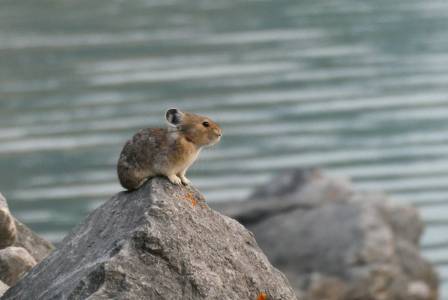
Despite their soft appearance and harmless expression, American pikas are remarkably tough mammals capable of surviving some of North America's most demanding environments. As the smallest members of the lagomorph family, they have adapted to life in severe mountain conditions. They are also among the few mammals in the contiguous United States that spend their entire lives in alpine zones, occupying the cold and exposed terrain above the tree line where relatively few other species can persist.
Dorian Reeves
Writer
Lounge note
Settle in — the full story and key updates are below.
Desk
Entertainment
Despite their soft appearance and harmless expression, American pikas are remarkably tough mammals capable of surviving some of North America's most demanding environments. As the smallest members of the lagomorph family, they have adapted to life in severe mountain conditions. They are also among the few mammals in the contiguous United States that spend their entire lives in alpine zones, occupying the cold and exposed terrain above the tree line where relatively few other species can persist.
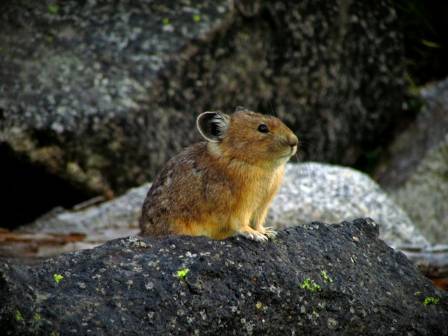
American pikas are tiny mammals with a body shape that can resemble a mouse. Their bodies are short, rounded, and compact, with large, round ears and no clearly visible external tail. Most adults reach only about 7 to 8 inches (18–20 centimeters) in length.
Their thick brown or dark-colored coats provide effective camouflage among the rocks and boulders of mountain habitats. During winter, their dense fur helps protect them from extremely low temperatures. In summer, they develop a lighter and thinner coat, but their substantial fur still leaves them particularly susceptible to overheating during prolonged periods of intense heat.
Range
Scientists think American pikas originated from ancestors that lived in Siberia and eventually entered North America by crossing the ancient Bering land bridge that once connected Asia with Alaska. Their historical distribution was considerably broader, but over the last 12,000 years their range has gradually shifted toward higher and cooler mountain environments.
Today, American pikas are primarily associated with high-altitude mountain habitats west of the Rocky Mountains. Their distribution extends through portions of Montana, Wyoming, Colorado, Idaho, Washington, Oregon, California, Nevada, Utah, New Mexico, and western Canada.
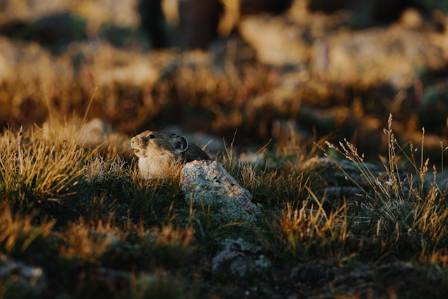
These mammals generally occupy alpine areas above the tree line, especially rocky mountainsides, cliffs, and talus slopes. Talus fields consist of loose pieces of rock that accumulate near mountain meadows. While most populations in the lower 48 states depend on cold alpine conditions, certain populations occur at lower elevations where naturally cool environments are available. One example is the underground ice caves of Lava Beds National Monument in California.
Even in their isolated mountain habitats, American pikas face natural predators such as weasels, hawks, and coyotes.
Diet
American pikas are herbivores that obtain nearly all of their food from the vegetation growing in their mountainous surroundings. Their diet commonly includes grasses, wildflowers, herbs, and other alpine plants.
Because vegetation becomes much less available during the winter months at high elevations, pikas spend the warmer season preparing for the coming cold. Throughout summer, they collect substantial quantities of plants and arrange them into storage piles close to their shelters. These food reserves are commonly known as “haypiles.”
Before putting plants into storage, pikas place grasses and flowers in sunny areas where they can dry naturally. This process helps limit mold growth. Once dried, the vegetation is stored within their rocky shelters and serves as an important food source throughout winter.
Behavior
American pikas possess a variety of adaptations that enable them to live in severe alpine environments characterized by freezing temperatures, powerful winds, and large areas of exposed rock.
Because their mountain homes can be isolated and potentially dangerous, pikas commonly live in small colonies. Communication plays an important role in their survival. When a predator approaches, they produce sharp alarm calls that warn other nearby individuals of the potential threat.
Despite living in close proximity to one another, American pikas are strongly territorial. Each animal defends its own rocky shelter and the surrounding area where it feeds. They use particular vocalizations to mark boundaries and interact with neighboring individuals.
Unlike many other small mammals, American pikas do not enter hibernation. They remain active throughout the year, although winter weather causes them to spend more time inside their shelters. Their ability to survive the cold season depends heavily on the vegetation they collected during summer, and they generally venture outside only when conditions are suitable for foraging.
Life History
The breeding period for American pikas begins in early to mid-spring. Many females are capable of producing two litters within a year, with one litter arriving during spring and another during summer.
Following a gestation period of roughly one month, females give birth to between two and six young. Newborn pikas depend entirely on their mothers and are unable to survive without parental care. They remain dependent for several weeks before gradually developing the ability to live more independently.
Young pikas are generally weaned at around one month of age and reach approximately adult size by about three months. At roughly one year old, they become capable of reproducing.
Some American pikas may live for six or seven years, although many wild individuals survive for only around three to four years.
Conservation
Polar bears have long been viewed as one of the most recognizable symbols of the effects of climate change. American pikas, however, have increasingly attracted similar attention because their survival is closely tied to cool mountain conditions and they are particularly sensitive to increasing temperatures.
Warming temperatures are changing the alpine environments on which pikas depend. In certain regions, including parts of Oregon and Nevada, American pikas have already vanished from more than one-third of the locations where they were historically documented.
Despite these population and range reductions, American pikas are not currently protected by the U.S. Endangered Species Act. Researchers caution that without effective conservation efforts, the species could become one of the earliest mammals to disappear as a direct consequence of climate-related environmental changes.
Pikas rely on cold and moist alpine ecosystems. They are adapted to environments where temperatures generally remain near or below freezing, but prolonged exposure to temperatures of approximately 78°F (26°C) can cause fatal heat stress.
Many mountain animals can respond to warmer conditions by moving toward higher elevations. American pikas face a major limitation because they already occupy some of the highest available parts of mountains. As temperatures rise further, there are increasingly fewer places for them to move in search of suitable conditions.
Climate change is also creating other pressures for alpine wildlife. These include shifts in plant communities, greater competition from species entering new areas, increases in predators and pests, reduced winter snow cover, and a higher frequency of extreme weather events.
In the Great Basin, a region situated between the Rocky Mountains and California's Sierra Nevada, researchers have already recorded reductions in pika populations. Scientists suggest that these changes could provide an early indication of wider ecological effects that may eventually influence other mountain species, including insects, birds, and larger mammals.
Interesting Fact
American pikas are frequently heard before they are seen. They produce a variety of vocalizations for defending their territories, alerting nearby pikas to approaching predators, and attracting potential mates.
Their unusual calls are sometimes likened to the sound of a very small lamb, although the pika's voice is considerably higher in pitch and has a distinctive squeaky quality.
More to explore

· en
Oil Painting: A Profound Outlet for Self-Expression
Mason Blake

· en
Top 5 Most Comfortable Sofas of 2026
Miles Lawson

· en
The Art of Ambiance: The Definitive Guide to Choosing, Styling, and Living with Table Lamps
Riley Cooper

· en
Amazing Cliff Jumps Around the World
Stellan Hayes

· en
How to Style a Qipao With Grace – A Complete Cheongsam Guide for Every Setting
Charlotte

· en
Racing Steel: The World’s 10 Fastest High-Speed Trains
Alex