Feature story
Turkey’s ‘Fairy Chimneys’ Were Millions of Years in the Making
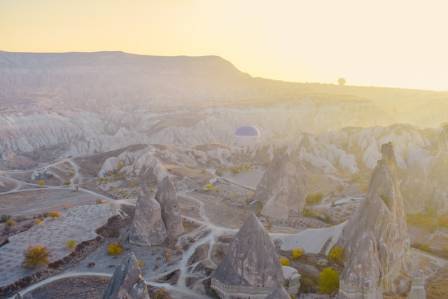
On the elevated plains of central Anatolia in Turkey, the landscape of Cappadocia can look almost too strange to be real. Tall, narrow rock formations rise from the ground like thin stems topped with oversized mushrooms. Their unusual appearance is so surreal that it seems as though they belong in a fantastical painting rather than in the natural world.
Lyra Bennett
Writer
Lounge note
Settle in — the full story and key updates are below.
Desk
Entertainment
On the elevated plains of central Anatolia in Turkey, the landscape of Cappadocia can look almost too strange to be real. Tall, narrow rock formations rise from the ground like thin stems topped with oversized mushrooms. Their unusual appearance is so surreal that it seems as though they belong in a fantastical painting rather than in the natural world.
It is easy to understand why these formations became known as “fairy chimneys.” Their strange shapes seem to suggest some supernatural force at work. Yet their origins are entirely natural, the result of geological events and erosion that unfolded over millions of years.
How the Fairy Chimneys Were Formed
The story of the fairy chimneys began millions of years ago when powerful volcanic eruptions spread thick layers of ash across the region that would eventually become modern-day Turkey.
Over time, the ash compacted and hardened into tuff, a lightweight and porous type of volcanic rock. A tougher layer of basalt later formed over parts of the tuff, creating a protective covering.
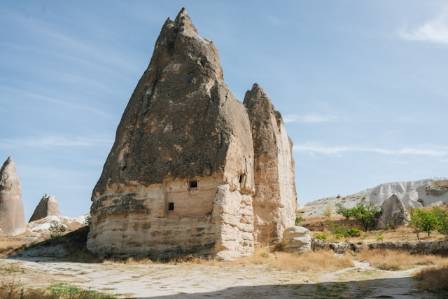
Then erosion began its incredibly slow work. Wind, rain, snow, and other natural forces gradually wore away the softer tuff surrounding the harder material. As thousands and eventually millions of years passed, tall columns remained standing while the surrounding landscape disappeared.
Some of these pillars reach heights of approximately 130 feet. Because the harder basalt at the top erodes more slowly than the softer rock beneath it, it forms a broad protective cap. The resulting structure resembles a giant mushroom, producing the distinctive form of the fairy chimney.
No supernatural ingredients were needed. Millions of years of volcanic activity followed by patient erosion were enough to create the landscape.
A Landscape Filled With Human Stories
Although the geological origins of the fairy chimneys are completely explainable, the human history surrounding them adds an undeniable sense of wonder.
For centuries, people have found remarkable ways to adapt these unusual formations for shelter, worship, and everyday life. The caves and rock towers became part of a human landscape whose stories are almost as fascinating as the geological processes that created the formations themselves.
Cappadocia and the Silk Road
The fairy chimneys are found in the historic region of Cappadocia, an area connected to the ancient Silk Road trade network.
Because of its strategic location, Cappadocia repeatedly became the target of powerful kingdoms and empires. Over the centuries, the region was controlled or influenced by many major powers, including the Hittites, Persians, Alexander the Great, Romans, Byzantines, and eventually the Ottomans.
The area's turbulent history meant that its inhabitants often had to find ways to protect themselves from invading armies and political conflicts.
Christians and the Rock-Cut Settlements
During the Roman era, large numbers of Christians facing persecution moved into Cappadocia, particularly around Göreme.
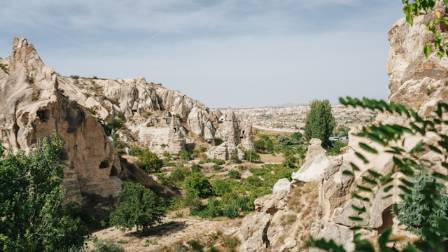
They soon discovered that the region's soft tuff could be carved relatively easily. Using this natural material, they excavated homes, chapels, monasteries, and other spaces directly into the fairy chimneys and surrounding rock.
Over time, existing caves were expanded into enormous underground settlements. Places such as Kaymakli and Derinkuyu developed into extensive subterranean cities capable of sheltering thousands of people.
These underground communities provided protection during periods of danger and allowed residents to retreat below the surface when enemies approached.
Underground Cities and Hidden Defenses
The tunnels beneath Cappadocia were not simply places to hide. They were carefully designed environments that could support communities for extended periods.
When invasions threatened, local residents could descend into the underground passages and seal entrances with massive stone doors. Some areas also incorporated ingenious defensive features designed to make it difficult for outsiders to enter.
For generations, these underground networks offered a way for people to disappear from the surface and protect themselves from invading forces.
Today, the rock formations, cave dwellings, and underground settlements form an extraordinary connection between Cappadocia's natural history and its human past.
A World Heritage Landscape
The rock formations of Cappadocia and Göreme National Park are now recognized as a UNESCO World Heritage Site. UNESCO has described the area as one of the world's most remarkable and extensive collections of cave dwellings.
The designation reflects both the extraordinary geological landscape and the cultural heritage carved into it by generations of inhabitants.
Visitors can explore many of the ancient rock-cut structures, while some caves and fairy chimneys have been adapted for modern use.
Sleeping Inside the Fairy Chimneys
One of the most unusual ways to experience Cappadocia is to stay inside one of its traditional caves or rock formations.
Some former cave dwellings and fairy chimneys have been transformed into distinctive hotels, allowing travelers to spend the night within structures that were originally shaped by human hands and natural forces.
This combination of ancient architecture and modern hospitality provides a rare opportunity to experience the landscape from within rather than simply viewing it from the outside.
Where Nature and Human Ingenuity Meet
The fairy chimneys are ultimately the result of an extraordinary partnership between geology and human creativity.
Volcanic eruptions created the original layers of ash, which eventually became soft tuff. Erosion then sculpted that material into towering pillars protected by harder caps. Millions of years later, people recognized the possibilities offered by the unusual landscape and carved their homes, churches, shelters, and underground cities directly into it.
The formations may not have been created by magic, but their appearance and history still possess an almost otherworldly quality.
Cappadocia demonstrates how nature can create something astonishing over immense periods of time, while human beings can transform that natural wonder into places to live, worship, and seek refuge. The fairy chimneys therefore represent not only a geological miracle but also a remarkable record of human ingenuity.
More to explore

· en
A Guide to Train Travel in the USA
Leon Fairmont
· en
The Grand Foundation and Early Origins of the Royal Ontario Museum
Florence Merriweather

· en
Key Points to Keep in Mind When Cleaning Your Bathroom
Acacia
· en
Kangaroos are the largest animals that move by hopping.
Ethan Parker
· en
The Most Striking Crater Lakes on Earth
Nola Reeves

· en
The Definitive Handbook for Contemporary Men’s Outerwear
Nathaniel Ryan Pembroke