Feature story
The Most Striking Crater Lakes on Earth
Often considered one of the most famous caldera lakes in the United States, Crater Lake is the centerpiece of Crater Lake National Park. Reaching a depth of 2,148 feet, the lake formed around 5,667 B.C. when Mount Mazama erupted and subsequently collapsed.
Nola Reeves
Writer
Lounge note
Settle in — the full story and key updates are below.
Desk
Entertainment
Crater Lake, Mount Mazama, Oregon
Often considered one of the most famous caldera lakes in the United States, Crater Lake is the centerpiece of Crater Lake National Park. Reaching a depth of 2,148 feet, the lake formed around 5,667 B.C. when Mount Mazama erupted and subsequently collapsed.
Before the catastrophic event, the stratovolcano held great spiritual importance for the local Klamath people, who associated it with Llao, their god of the underworld. The Klamaths witnessed the mountain’s destruction and preserved the event in their traditions as a tremendous conflict between Llao and Skell, the sky god.
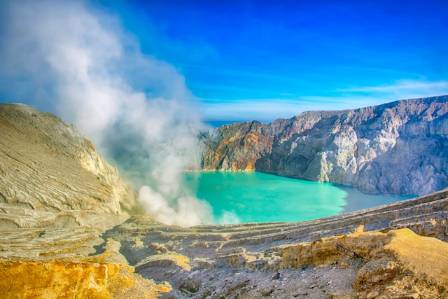
Blue Fire Crater, Kawah Ijen Volcano, Indonesia
The striking mint-green color of Kawah Ijen’s crater lake can be misleading. Beneath its beautiful appearance is an extremely acidic body of sulphuric acid. According to the Smithsonian’s Global Volcanism Program, it is considered the largest highly acidic lake on Earth. Large amounts of sulphur accumulate around the shoreline, and the crater is also the site of an active sulphur mine. Miners are often seen carrying heavy baskets filled with vivid yellow pieces of solid sulphur up the steep slopes from the lake.
In recent years, the crater has attracted increasing numbers of visitors, partly because of international attention surrounding its extraordinary blue flames. This unusual phenomenon occurs when sulphur gases escape through cracks in the ground and ignite.
Mount Katmai, Alaska
Deep in southern Alaska’s Katmai National Park and Preserve lies a remote crater lake within the caldera of a 6,716-foot-tall stratovolcano. The Mount Katmai caldera spans roughly 6.3 miles across and was created in 1912 following the initial eruption of the nearby Novarupta volcano.
Okama Lake, Mount Zao, Honshū, Japan
Okama Lake is famous for its vivid turquoise appearance, although the water can shift through several different shades. This remarkable feature has earned it the nickname “Five Color Pond.” Created through a complicated volcanic eruption during the 18th century, the lake is approximately 1,200 feet across and reaches a depth of around 200 feet.
Lake Tritriva, Vàkinankàratra, Madagascar
About half an hour from the city of Antsirabe, Lake Tritriva is a small but spectacular volcanic lake enclosed by steep cliffs made of gneiss. Swimming is possible, but the water is extremely cold and reaches extraordinary depths of more than 160 meters. For a sense of how deep that is, consider the height of a 160-meter bridge, from which a man has been filmed performing a bungee jump.
Kerid, Grímsnes, Iceland
Iceland is filled with dramatic landscapes that can seem almost unreal, and the Kerid crater in the country’s Western Volcanic Zone is one of them. Called “Kerið” in Icelandic, this relatively shallow lake contains abundant minerals and is encircled by steep walls of reddish volcanic rock, with patches of moss and other vegetation scattered across the slopes.
The caldera reaches approximately 55 meters in depth, while the lake itself is generally between 7 and 14 meters deep. Its water level changes depending on the amount of rainfall.
One of the easiest ways to visit Kerid is by following Iceland’s well-known Golden Circle route. This approximately 300-kilometer circuit connects many of the most impressive natural attractions in southern Iceland.
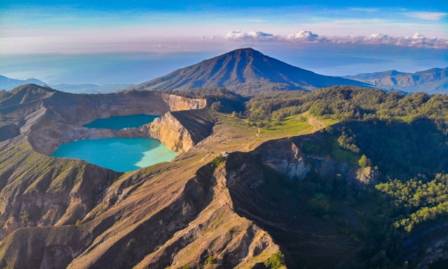
Kelimutu, Flores, Indonesia
Kelimutu is home to three volcanic lakes. The two shown here are Tiwu Ko'o Fai Nuwa Muri, meaning Lake of Young Men and Maidens, and Tiwu Ata Polo, also called Bewitched Lake. A single volcanic crater wall separates them. The third lake is known as Tiwu Ata Bupu, or Lake of Old People.
What makes this group particularly remarkable is that the three lakes can display different colors even though they occupy the summit of the same volcano. Their changing hues are linked to chemical interactions between minerals in the water and variations in volcanic gases.
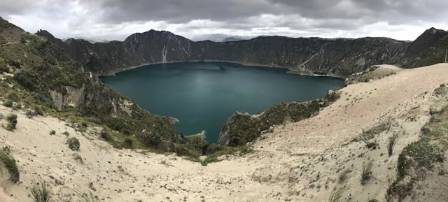
Quilotoa, Andes Mountains, Ecuador
This water-filled caldera developed after a massive volcanic eruption roughly 800 years ago and has gradually become an increasingly popular destination for travelers. The turquoise lake occupying the crater is well worth the journey and hike required to reach it.
Because the lake is acidic, however, swimming is not a suitable way to celebrate reaching the water. Instead, visitors can enjoy the spectacular scenery from different viewpoints around the crater rim.
Pingualuit Crater, Ungava Peninsula, Quebec, Canada
Previously called the Chubb Crater, Pingualuit is relatively young when viewed on a geological timescale. Scientists estimate that the meteorite impact responsible for creating the crater happened approximately 1.4 million years ago, with an uncertainty of around 100,000 years, placing the event within the Pleistocene epoch.
The crater sits amid an austere tundra landscape and contains a lake recognized as one of the deepest in North America. Its freshwater is also exceptionally clear and pure. The transparency is remarkable enough that a Secchi disc, an instrument used to determine water clarity, can remain visible at depths of approximately 35 meters below the surface.
More to explore
· en
Fascinating Insights into the Australian Magpie
Lily Ward
· en
Unraveling the Wonders of Coconut Palms
Zoey Harper
· en
Four Key Features of a Healthy Forest
Nathan Scott
· en
Coastal Towns and Villages
Rowan Sinclair
· en
Paragliding: Global Hotspots, Weather Dynamics, and Safety Essentials
Mia
· en
How to Grow and Care for Asparagus Fern
Emma Wallace