Feature story
History of Schönbrunn Palace
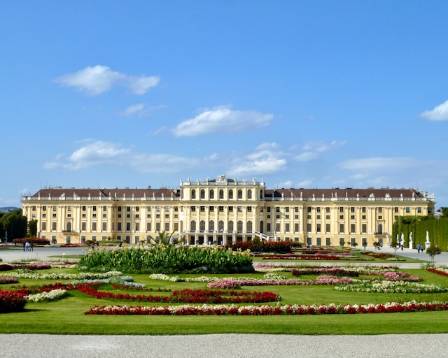
What began as a royal hunting retreat has evolved into one of Austria’s most celebrated landmarks, attracting roughly 3 million visitors every year. For much of its history, Schönbrunn served as the imperial family’s summer residence and is admired for both its grand exterior and richly decorated interiors. The palace contains 1,441 rooms, although visitors can access only 40 of them.
Vera Camden
Writer
Lounge note
Settle in — the full story and key updates are below.
Desk
Entertainment
What began as a royal hunting retreat has evolved into one of Austria’s most celebrated landmarks, attracting roughly 3 million visitors every year. For much of its history, Schönbrunn served as the imperial family’s summer residence and is admired for both its grand exterior and richly decorated interiors. The palace contains 1,441 rooms, although visitors can access only 40 of them.
The Meaning of “Beautiful Spring”
In 1569, Holy Roman Emperor Maximilian II acquired an extensive property that included a manor known as Katterburg. He enclosed the grounds with fences and transformed the estate into a recreational hunting area for the imperial court.
The property was later inherited by Eleonora Gonzaga. Between 1638 and 1643, she expanded the existing manor by adding a palace, and the name Schönbrunn appeared for the first time. The word means “Beautiful Spring” and refers to an artesian spring on the estate that supplied water to members of the court.
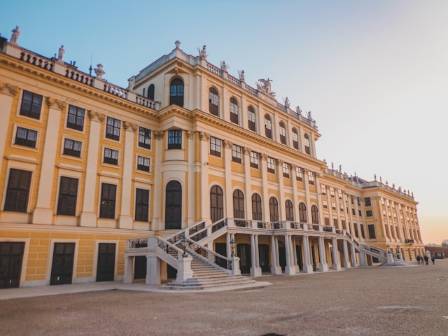
The palace as it appears today was reconstructed during the 1740s and 1750s under Empress Maria Theresa, who received Schönbrunn as a wedding gift and turned it into the imperial summer residence.
Today, Schönbrunn is regarded as one of Austria’s most significant cultural monuments. In 1996, the palace and its grounds were added to the UNESCO World Heritage List.
Palace Gardens and the World’s Oldest Zoo
The extensive Schönbrunn gardens contain far more than their 32 sculptures. Among their highlights is the 60-meter-high Gloriette, which stands prominently opposite the palace. Visitors can also explore the Roman Ruin, a maze, the Palm House with its impressive botanical collections, an orangery, and what is recognized as the world’s oldest zoo.
The section of the grounds west of the palace was also developed as a recreation and training area for the children of the Habsburg family.
The Musical Heritage of Schönbrunn
Music occupied an important position in the lives of the Habsburg rulers. Wolfgang Amadeus Mozart visited Schönbrunn as a six-year-old child, where he performed for the imperial family on October 13 and October 21, 1762. Another major composer associated with the palace was Joseph Haydn, who arrived there as a choirboy to participate in a musical performance.
Following French palace traditions, an Orangerie was constructed as part of Schönbrunn. It was designed not only to protect citrus trees and other delicate plants during the colder months but also became the setting for one of the most famous musical competitions of its era.
Mozart and Salieri at the Orangerie
Emperor Joseph II organized a celebration to publicly express his affection for his sister, who was visiting Vienna from Brussels. For the occasion, he commissioned Wolfgang Amadeus Mozart and his rival Antonio Salieri to create operas that would be performed at opposite ends of the Orangerie.
The spectators were positioned between the two performances, allowing them to hear one production and then simply turn around to listen to the other.
Salieri presented Prima la Musica, poi le Parole, or First the Music and then the Words, following the fashionable Italian operatic tradition. Mozart responded with Schauspieldirector, or The Impresario, which served as a challenge to Salieri and a defense of German opera.
The evening ultimately proved highly successful for Salieri and his Italian opera. Mozart’s humorous portrayal of German theatrical personalities could not compete with Salieri’s more polished combination of music and poetry.
The Orangerie Today
After this famous musical event, the Orangerie continued to serve as a location for celebrations and performances. Today, its musical tradition remains alive through concerts featuring works by Wolfgang Amadeus Mozart and Johann Strauss.
Visiting Schönbrunn Palace
The combination of magnificent gardens, elegant Baroque architecture, the world’s oldest zoo, and a fascinating musical and cultural legacy makes Schönbrunn Palace one of Vienna’s most popular attractions.
A full day at Schönbrunn allows visitors to explore the former private rooms of the imperial family, wander through the extensive palace gardens, discover the historic attractions throughout the grounds, and attend a classical concert at one of Vienna’s renowned performance venues.
More to explore

· en
What is a sambar deer?
Nathan Cole
· en
How to Create Atmosphere in the Garden With Light and Shadow
Lydia Foster
· en
Outstanding Historic Beacons of the United States and Their Extraordinary Chronicles
Oscar Bennett

· en
Health Benefits of Exercise
Lucian Graves

· en
UAE Desert Adventures: Embrace Tranquility Beneath Starry Skies
Amelia Quinn
· en
The Art of Modern Washū: 9 Architect-Designed Living Rooms & Key Elements of Elevated Style
Daisy Chapman