Feature story
Ancient Pyramids Around the World
Egypt contains over a hundred pyramids, yet this one marks the beginning of them all. It was constructed during the rule of Pharaoh Djoser (around 2630–2611 B.C.) as a monumental burial structure. Earlier royal tombs were simple flat structures made of mudbrick, but architect Imhotep introduced a groundbreaking idea: stacking six limestone tiers of decreasing size to form a “step pyramid” rising about 200 feet. Imhotep, who was also associated with healing, was later honored as a divine figure in later traditions.
Ella Thompson
Writer
Lounge note
Settle in — the full story and key updates are below.
Desk
Entertainment
Egypt contains over a hundred pyramids, yet this one marks the beginning of them all. It was constructed during the rule of Pharaoh Djoser (around 2630–2611 B.C.) as a monumental burial structure. Earlier royal tombs were simple flat structures made of mudbrick, but architect Imhotep introduced a groundbreaking idea: stacking six limestone tiers of decreasing size to form a “step pyramid” rising about 200 feet. Imhotep, who was also associated with healing, was later honored as a divine figure in later traditions.
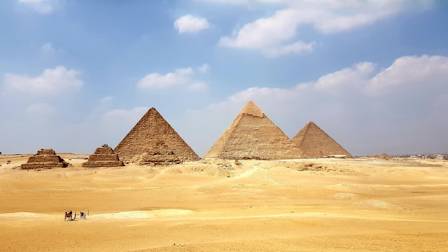
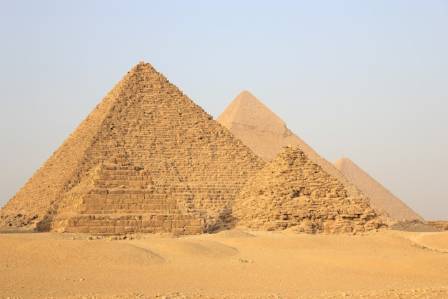
Giza, Egypt: Great Pyramid of Khufu
When people think of pyramids, this is usually the image that comes to mind—three massive structures rising from the desert near modern Cairo. The largest, built around 2551 B.C. for Pharaoh Khufu, is known as the Great Pyramid. Constructed from over two million stone blocks, it originally stood at 481 feet and remains the largest ancient pyramid ever built. For more than 3,000 years it held the record as the tallest human-made structure, and it is the only surviving Wonder of the Ancient World.
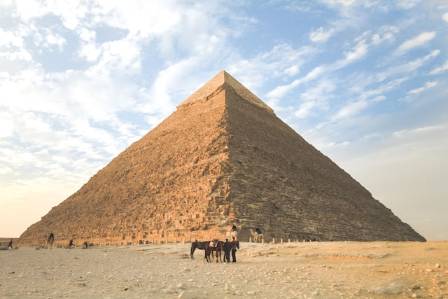
Giza, Egypt: Pyramid of Khafre
This is the second major pyramid in the Giza complex, built around 2520 B.C. for Pharaoh Khafre. Although slightly shorter than Khufu’s pyramid, it appears taller due to its higher foundation. Nearby lies an impressive temple complex and the famous limestone statue with a human head and lion body, known today as the Sphinx, one of antiquity’s most enigmatic monuments.
Chavín de Huántar, Peru: Chavín Temple Complex
Constructed over centuries by the Chavín culture (roughly 900–200 B.C.), this Andean site includes both older and newer temple structures. Built from stone blocks and arranged in stepped, pyramid-like forms, the complex features tunnels, carved stone designs, and water channels likely used in rituals. Although partially ruined today, its scale once led early Spanish observers to assume it was created by giants.
Teotihuacán, Mexico: Pyramid of the Sun
Little is known about the builders of Teotihuacán, but their engineering skills were extraordinary. The city, active in the early centuries A.D., covered a vast planned urban area with several pyramids. The Pyramid of the Sun is the largest, with a base nearly 730 feet wide and an original height exceeding 200 feet. It stands along the central “Avenue of the Dead,” connecting major ceremonial zones.
Meroë, Sudan: Nubian Pyramids
In ancient Nubia, hundreds of pyramid-shaped tombs were constructed, many using reddish sandstone. Around 40 remain at Meroë, once a royal center of the Kushite kingdom (300 B.C.–300 A.D.). These pyramids are narrower and smaller than their Egyptian counterparts. Over time, many were damaged or looted, but they still form a striking archaeological landscape.
Cholula, Mexico: Great Pyramid of Cholula
What appears today as a grassy hill in Puebla is actually a massive ancient structure covering about 45 acres. Known formally as Tlachihualtepetl, this pyramid was built in multiple stages by pre-Hispanic civilizations and later used by the Aztecs as a temple dedicated to Quetzalcoatl. After the Spanish conquest, a church was built on top, blending indigenous and colonial history in a single landmark.
Ur, Iraq: Ziggurat of Ur
The term “ziggurat” refers to stepped temple towers from Mesopotamia, and this is one of the most famous examples. Built for King Ur-Nammu around the 21st century B.C., it originally had multiple terraces connected by stairways and a shrine at the top dedicated to a moon deity. It was later restored in antiquity and again in modern archaeological efforts, and it remains near a present-day military site.
Tikal, Guatemala: Mayan Pyramids
Tikal served as a major Maya cultural and ceremonial center between 300 and 900 A.D. The site contains several towering pyramid-temples, the tallest reaching about 213 feet and crowned by the Temple of the Two-Headed Serpent. After being abandoned, the city was overtaken by jungle until rediscovered in the 19th century, later becoming a UNESCO World Heritage Site.
Rome, Italy: Pyramid of Cestius
This sharply angled pyramid was built around 12 B.C. as the tomb of Roman official Gaius Cestius Epulo. Inscriptions identify both him and his heirs, noting that construction took just over 300 days. Built from concrete and faced with marble, it also contains interior frescoes. In the 19th century, poet Thomas Hardy reflected on the structure while noting how easily history forgets the individuals behind such monuments.
More to explore

· en
Mountain Lakes of the High Sierra
Elara Winslow

· en
Snow Leopards Have Extremely Low Genetic Diversity
Stellan Royce

· en
The Enchantment of the Window Seat: A Journey Through the Skies
Harper Luna
· en
Tapirs: Ancient Relatives of Horses and Rhinos
Chloe
· en
Amazing Cliff Jumps Around the World
Stellan Hayes
· en
Watercolor painting of a narrow Venice canal
Avery Lane