Feature story
The Secret Life of Hermit Crabs
A few years ago, I was fortunate enough to spend some time on a remote island in the backcountry. There was a house on the island, but it was essentially off the grid, far from the pipes and electrical lines that connect most of the modern world. Every now and then, you could still manage to send or receive a text message, particularly if you climbed onto the roof.
Kellan Voss
Writer
Lounge note
Settle in — the full story and key updates are below.
Desk
Entertainment
A few years ago, I was fortunate enough to spend some time on a remote island in the backcountry. There was a house on the island, but it was essentially off the grid, far from the pipes and electrical lines that connect most of the modern world. Every now and then, you could still manage to send or receive a text message, particularly if you climbed onto the roof.
Apart from enjoying the untouched beauty of the surroundings, one of my favorite pastimes was to push whatever scraps remained on my dinner plate over the porch railing and wait to see what would appear. Beneath the porch was a bare patch of sand covered with tracks. They looked almost like writing in an unknown language, created by countless tiny pairs of uneven feet.
The hermit crabs were dependable visitors, although they were certainly not fast. Most of the time, they stayed hidden in the shadows until something gave them a good reason to venture out.
I never figured out whether they were responding to the smell of the food, the noise it made when it landed, or perhaps the vibrations traveling through the sand. Usually, one of the smaller crabs would detect the meal first and slowly head toward whatever was closest, whether it was a pork chop bone, part of a tater tot, a piece of bread crust, a scrap of fish, a slice of pepper, or a strangely shaped pile of rice.
It is easy to become impatient with how slowly hermit crabs move. But from their perspective, the distance was probably much greater than it appeared to us. Six feet of sand for one of these crabs might be comparable to a person having to cross roughly 200 yards. On top of that, the crab has to carry its home everywhere it goes, even though that shell was never originally designed for the crab itself.
It usually began with a single crab. But once one hermit crab established a route toward a food source, the others seemed to take notice. The first arrival would get a minute or two to eat, using the smaller of its two claws to push pieces of food into its mouth. Then other hermits of roughly the same size would appear, followed by larger individuals. It sometimes seemed as though the bigger crabs only became interested after the smaller ones beneath them in size had already started moving.
Before long, the area could become a writhing mass of hermit crabs, with animals piling over practically every piece of food that had fallen into the sand. Sometimes they behaved peacefully. At other times, fights broke out. Their confrontations always made me think of low-budget clay animation.
Once, I dropped a navel orange into the sand and recorded what happened. After a little while, one of the larger hermit crabs arrived and climbed onto the fruit. It reminded me of the cover art for The Little Prince, except that this version featured a large hermit crab that somehow brought Jack Reacher to mind.
Before long, the crab had created an opening in the orange peel and began lowering its smaller claw into the hole, pulling out mouthfuls of juicy pulp. From time to time, a smaller crab would approach as though it wanted to challenge the dominant animal. Each time, the larger crab simply knocked the challenger away.
Eventually, an even bigger hermit crab arrived. This one looked like an even more intimidating version of the first. The two engaged in what looked like a damp, floppy slap fight involving their antennae. Eventually, the larger crab managed to get a firm grip on the orange peel, climbed onto the fruit, and tossed the slightly smaller crab away as casually as someone might throw aside an old suitcase.
In every confrontation between hermit crabs that I witnessed, the larger animal eventually prevailed. The smaller crabs, however, never seemed willing to surrender without putting up some resistance. None of the losers appeared to suffer obvious injuries. The contests seemed less like attempts to seriously harm one another and more like a way of establishing who had priority.
Eventually, I realized that I needed to look beyond the miniature UFC matches and learn more about what was actually happening.
There are roughly 600 species of hermit crabs worldwide, but only a few dozen of them are land-dwelling species. In the Florida Keys and throughout much of the Caribbean, one of the species we encounter is the Caribbean hermit crab. It is also known by names such as the Purple Pincher, Tree Crab, and Soldier Crab. Its scientific name is Coenobita clypeatus.
Caribbean hermit crabs are one of only two hermit crab species commonly sold in pet stores across the United States. The other is the Ecuadorian hermit crab. Neither species can currently be bred in captivity, meaning the animals sold as pets are collected from the wild.
A wild hermit crab can survive for around 12 years. Captive animals, however, often live for only a few months. There is at least one extraordinary exception: a crab named Johnathon Livingston Crab. Her owner purchased her on the Maryland coast in 1976. Despite the name suggesting otherwise, Johnathon was actually female, and she survived in captivity for more than 45 years.
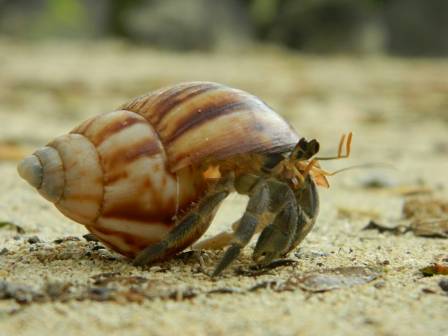
Hermit crabs are not actually true crabs. They are more closely related to lobsters. As their name implies, they do not produce their own shells. Instead, roughly 150 million years ago, they evolved the ability to occupy shells abandoned by other animals, most commonly gastropods such as marine snails.
They are also remarkably adaptable when it comes to finding shelter. The first hermit crab I remember encountering in the Florida Keys was living inside a plastic shampoo-bottle cap on Boca Chica Beach.
The front portion of a hermit crab’s body is protected by a hard exoskeleton, while the rear section is soft and flexible. The back portion is shaped so that it can curl into the spiral interior of the shell the animal chooses.
Hermit crabs have ten legs in total. The front pair has evolved into claws, while the following four legs are primarily used for walking. The final four are considerably smaller and help the crab maintain its grip inside its shell.
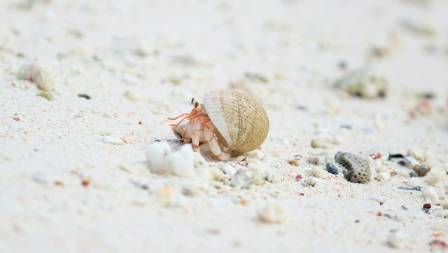
I have encountered hermit crabs occupying shells barely larger than a pencil point, as well as individuals living in shells almost the size of a lemon. As they grow, they need to find larger homes, generally replacing their shells every year to year and a half.
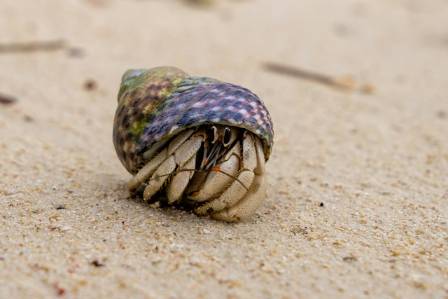
There appear to be two primary ways that hermit crabs accomplish this upgrade. In the simplest situation, a crab encounters an abandoned shell that is large enough for it and simply leaves its current home behind before moving into the new one. Interestingly, when given the choice between a shell previously occupied by another hermit crab and an otherwise identical shell that has never been used, they reportedly choose the previously occupied shell almost every time.
The second method is much more cooperative. When a large hermit crab discovers a suitably large empty shell while other hermit crabs are nearby, it can move into the new home and leave its old shell behind. The next-largest crab then takes over that shell, leaving its previous shell available for the next smaller crab. The process continues down the size chain, with each animal moving into the shell abandoned by the one immediately larger than itself. In this way, an entire group can effectively upgrade their homes one after another.
I never got to witness this remarkable chain of shell exchanges during my time on that remote island, nor have I encountered it anywhere else while exploring the Florida Keys. But I am still hoping that one day I will get the chance.
More to explore
· en
Top Handmade Items to Craft and Sell in 2025
Elizabeth Nelson
· en
Coastal Towns and Villages
Rowan Sinclair
· en
Seeking the world’s largest glaciers
Ronan Whitlock
· en
American Pika: The Tiny Mountain Survivor Facing a Changing Climate
julia
· en
The Horned Grebe: An Aquatic Specialist
Michael Reynolds

· en
What is Snowboarding?
Ronan Frost