← Back home3 min read
Feature story
10 Fun Facts About Kanazawa
The city enjoys a remarkable geographical setting — on the western coast of Japan’s main island Honshū, it faces the Sea of Japan, while to the east rise the dramatic peaks of the Japan Alps. This contrast of sea and mountain gives Kanazawa both strong maritime influences and alpine scenery, shaping its climate, cuisine and culture.
S
Sophia Turner
Writer
Lounge note
Settle in — the full story and key updates are below.
Desk
Entertainment
Kanazawa is surrounded by the Sea of Japan and the Japan Alps.
The city enjoys a remarkable geographical setting — on the western coast of Japan’s main island Honshū, it faces the Sea of Japan, while to the east rise the dramatic peaks of the Japan Alps. This contrast of sea and mountain gives Kanazawa both strong maritime influences and alpine scenery, shaping its climate, cuisine and culture.
The word “Kanazawa” (金沢) literally means “Gold Marsh”.
The very name hints at its heritage: “金” (kin) meaning gold, and “沢” (sawa) meaning marsh or swamp. The implication of a “gold-marsh” evokes an image of land rich in mineral or shimmering resources — a poetic and historical pointer to the city’s connection with gold.
The story of how the city received its name came from a peasant farmer who accidentally stumbled upon shiny gold dust flakes while he was digging for potatoes!
According to local legend, a simple potato-digger found tiny gold-dust particles in the soil near the marshy terrain. Thus the name “Gold Marsh” was born — linking everyday life (digging for potatoes) with a flash of mineral discovery, and providing Kanazawa a memorable folk origin story.
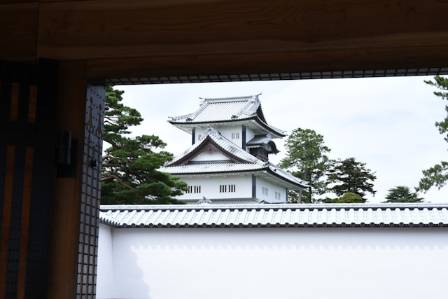
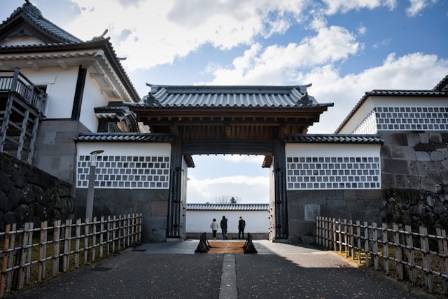
Kanazawa Castle features the original Ishikawa Gate from 1788.
One of the city’s enduring historic structures is the Ishikawa Gate of Kanazawa Castle, dating back to 1788. This gate has been designated as a National Important Cultural Property, and stands as a tangible link to the feudal era, offering visitors a window into architectural craftsmanship of the late 18th century.
The gate is designated as a National Important Cultural Property, one of many to be found in the city.
Kanazawa is rich in preserved historical assets — not just the Ishikawa Gate but numerous structures, districts and objects are formally recognized by Japan for their cultural significance. These designations help protect and highlight Kanazawa’s heritage, making the city a living museum of traditional Japan.
Kanazawa is the capital and largest city in Ishikawa Prefecture.
As the administrative and economic heart of Ishikawa Prefecture, Kanazawa plays a central role in politics, culture and commerce for the region. It is the prefecture’s largest urban centre, serving as the hub for transportation, industry and tourism on Japan’s west coast.
Kanazawa is 483 km from Tokyo, about the same distance as Buffalo to Albany.
Distance comparisons help highlight how accessible Kanazawa is relative to Japan’s major cities: the approximate 483 kilometres from Tokyo is comparable to familiar journeys in North America, helping international visitors contextualize travel time.
Thanks to the Shinkansen high-speed rail, travel time from Tokyo is only about 2½ hours.
While the distance is considerable, modern transport makes Kanazawa quite reachable. The Hokuriku Shinkansen allows rapid travel from Tokyo to Kanazawa in approximately two and a half hours — turning what might once have been a remote destination into a day-trip or 48-hour escape.
The Maeda clan, great patrons of the arts, ruled Kanazawa for nearly 3 centuries.
From the early Edo period and onward, the powerful Maeda family governed the Kaga domain (which included Kanazawa) for nearly three centuries. Their patronage of the arts, crafts and architecture laid the foundation for Kanazawa’s reputation as a cultural centre, attracting artists, craftsmen and scholars.
Kanazawa has been spared the worst from major wars or major weather disasters for the last 500 years!
One of the most remarkable aspects of Kanazawa is its continuity. The city has avoided large-scale destruction from war or natural catastrophe for half a millennium, allowing many of its historic districts, traditional houses and cultural practices to survive intact — a rare legacy in Japan.
More to explore

· en
How do solar panels work? Solar power explained
Ronan Everidge

· en
Who’s the Coolest Robot of All?
Evren Calder

· en
The Definitive Handbook for Contemporary Men’s Outerwear
Nathaniel Ryan Pembroke

· en
Facts about koalas!
Celia Dawn

· en
Homemade Matcha Tangyuan in Sweet Red Bean Soup
Damon Pierce
· en
Frozen Reservoirs: The Geology and Global Impact of Glaciers and Ice Sheets
Theodore Davis