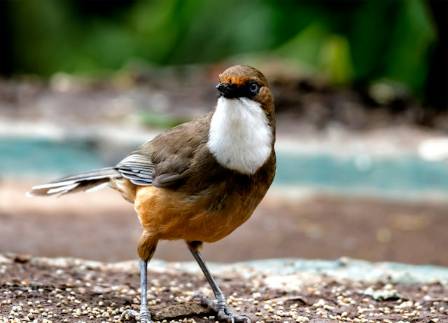
Feature story
The Remarkable Family Life of the White-Crested Laughingthrush
The White-crested Laughingthrush is a distinctive and remarkably sociable bird native to Southeast Asia. I have had the opportunity to encounter these engaging birds during two recent visits to zoos. Those experiences encouraged me to learn more about them, and I discovered many fascinating details that are worth sharing.
Livia West
Writer
Lounge note
Settle in — the full story and key updates are below.
Desk
Entertainment
The White-crested Laughingthrush is a distinctive and remarkably sociable bird native to Southeast Asia. I have had the opportunity to encounter these engaging birds during two recent visits to zoos. Those experiences encouraged me to learn more about them, and I discovered many fascinating details that are worth sharing.
A Memorable Encounter
Before going any further, I should admit that I have developed a bit of a personal fondness for these birds. During one recent zoo visit on an extremely cold day, I came across a White-crested Laughingthrush. There was no identification sign on the enclosure, so at first I had no idea what species I was looking at.
The bird that I now understand was a male immediately showed great interest in the small group of visitors standing outside his enclosure. He seemed determined to entertain us, repeatedly making his displeasure known whenever someone moved out of his sight. He would also move through his enclosure in an attempt to keep up with the visitors as they walked past.
He continued this behavior throughout the entire twenty minutes I spent standing outside the enclosure. Even after I finally walked away, I could still hear him calling after me. Of all the animals I saw that day, he was easily the most entertaining.
Distribution and Habitat
Laughingthrushes are divided among four different genera and are primarily associated with Southeast Asia. The White-crested Laughingthrush is scientifically known as Garrulax leucolophus and naturally occurs throughout the foothills of the Himalayas.
The species has also become established in Singapore and Malaysia. These populations originated from birds that escaped from captivity or were released after being kept in the pet trade.
White-crested Laughingthrushes remain relatively common throughout their natural range, and scientists therefore do not currently consider the species threatened in its native habitat. There have also been unverified reports of individual birds being seen living in the wild in both the United Kingdom and the United States.
Appearance and Social Behavior
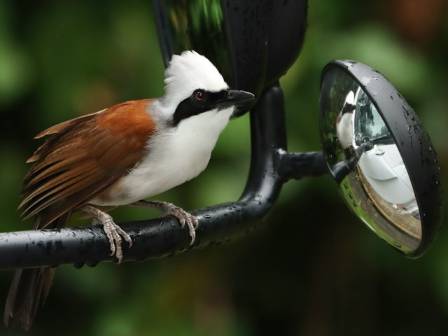
As its name suggests, the White-crested Laughingthrush has a prominent white crest on top of its head, which is one of its most recognizable characteristics. Its wings are generally a dull brown to mustard-brown color, while the head and chest are white.
A small grey area separates the wings from the neck. The bird also has a distinctive black stripe running through the eyes and ending near the grey patch on the neck.
The species is sexually dimorphic, meaning males and females can be distinguished by their physical appearance. The female has a noticeably smaller and less prominent crest, while the large, striking crest of the male is one of the defining features of his appearance.
As my zoo encounter demonstrated, these birds are highly social and often show considerable curiosity toward people, whether they are living in captivity or encountered in the wild. They commonly travel in groups of around eight to ten individuals, although larger groups containing as many as forty birds can occur.
Flight and Vocalizations
White-crested Laughingthrushes are not particularly powerful fliers. They often remain perched among jungle branches and will stay there until something disturbs them. When startled, they usually make a quick flight to another nearby tree rather than traveling long distances through the air.
Their vocalizations are especially distinctive. The species received its common name because some of its calls sound surprisingly similar to the laughter of a child.
Diet
The White-crested Laughingthrush has a varied diet. It commonly feeds on insects and may also take advantage of opportunities to consume small fish, reptiles, and amphibians.
During my recent zoo visit, I actually observed one of these birds being fed. It eagerly made a meal out of small bait minnows.
Breeding and Family Life
White-crested Laughingthrushes have a particularly interesting breeding system that is not commonly observed throughout the animal kingdom. Their breeding period generally extends from March through August, and males and females form very close bonds during this time.
They typically build their nests in bamboo, usually at least several feet above the ground. A pair may produce more than one clutch during a single breeding season.
The parents incubate the eggs for as long as seventeen days before the chicks hatch. Both the male and female participate in incubation and share responsibility for caring for their young once they emerge.
After spending roughly two weeks in the nest, the chicks are able to feed themselves and already resemble smaller versions of adult birds. Despite becoming independent in terms of feeding, however, they do not immediately leave the nesting area.
Instead, older fledglings remain nearby while their parents begin raising another brood. These older young birds help their parents care for the newly hatched chicks.
This cooperative behavior can continue throughout the breeding season. Some chicks that were weaned around the middle of March may still be assisting around the nest by the time the breeding season comes to an end.
The young birds reach sexual maturity during their second year. Around the same period, they attain their adult body length of just under twelve inches.
Questions About Instinct and Behavior
The White-crested Laughingthrush is fascinating not only because of its appearance and lifestyle but also because some of its behaviors raise interesting questions about how animal behavior develops.
Many of the species' social behaviors are also found in other birds, but they raise an important question: how does a bird understand what different calls mean?
How does it recognize that one sound signals danger, another indicates the presence of food, and another is simply a form of social communication?
Such abilities are generally understood as instinctive behaviors, meaning they are built into the animal rather than being learned through experience. This raises further questions about how instinct itself originates.
Unusually Strong Family Bonds
The White-crested Laughingthrush also displays unusually strong family relationships. One particularly remarkable behavior is the involvement of recently fledged young birds in raising younger chicks.
Having older offspring assist with the care of newly hatched chicks can reduce the workload placed on the parents. However, it also raises questions about why the older young remain and help.
From an evolutionary perspective, the fledged young will eventually compete with their younger siblings for resources such as food, mates, and shelter. Helping raise potential future competitors therefore appears to come at a cost to the older birds.
The newly hatched chicks, meanwhile, have no obvious reason to care about the genes carried by their older siblings. This makes the cooperative behavior particularly intriguing.
The strong family cooperation displayed by White-crested Laughingthrushes therefore continues to inspire questions about the origins of instinct, social behavior, and self-sacrificing cooperation in animals.
More to explore

· en
French Soufflé Recipe
Soren Vale

· en
World's biggest microscope to peer into the Big Bang
Lucan Briar

· en
Best Off-Road ATVs
Ethan Clark

· en
A Comprehensive Guide to Selecting Contemporary Indoor Planters for Your Greenery
Logan Samuel Montgomery

· en
Mango Pomelo Sago Dessert
Lucas Harris
· en
The Secret Lives of Squirrels
Dylan Reed