Feature story
Fujian Tulou: Ancient Earthen Castles of China
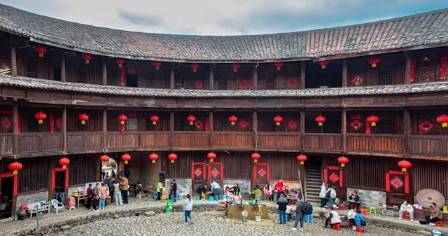
Fujian Tulou refers to a remarkable group of large earthen residences built from the 12th through the 20th centuries in the mountainous areas of southeastern Fujian, China. Designed to be highly resistant to outsiders, these structures typically rise several stories and follow circular or square layouts that face inward.
Levi Marlowe
Writer
Lounge note
Settle in — the full story and key updates are below.
Desk
Entertainment
Fujian Tulou refers to a remarkable group of large earthen residences built from the 12th through the 20th centuries in the mountainous areas of southeastern Fujian, China. Designed to be highly resistant to outsiders, these structures typically rise several stories and follow circular or square layouts that face inward.
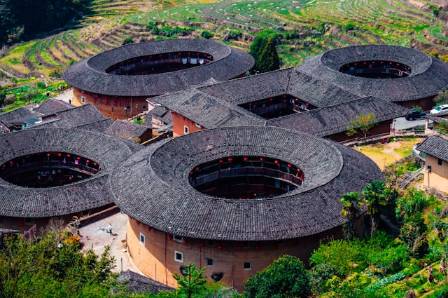
Their distinctive ring-shaped design surrounds a central courtyard and could accommodate as many as 800 residents, or roughly 80 families. The massive exterior walls have only a single entrance, while windows facing outward generally begin above the first floor.
These unusual communal homes were originally developed as defensive settlements in response to the threat of armed bandits that affected southern China between the 12th and 19th centuries. Communities in southern Fujian initially constructed fortified settlements on mountain slopes and peaks for protection. Over time, these early defensive structures developed into the distinctive Fujian Tulou seen today.
Strong Walls and Defensive Features
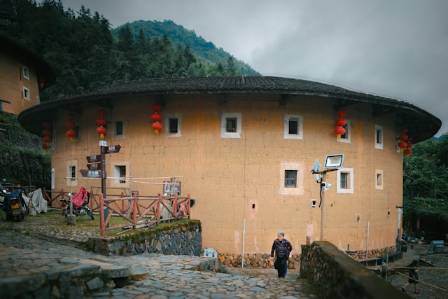
The fortified outer walls were created by compacting earth together with locally available materials such as stone, granite, bamboo, wood and other natural resources. In some structures, the walls can reach approximately six feet in thickness. Branches, wooden strips and pieces of bamboo were frequently incorporated into the compacted earth to strengthen the construction.
The entrances were protected by thick wooden doors, generally around four to five inches thick, with additional reinforcement provided by an exterior layer of iron plates. At the highest levels of many tulous, small openings were incorporated into the walls as gun ports, allowing residents to defend the buildings from attackers.
Built to Withstand Attacks
Fujian Tulou structures were exceptionally sturdy, with a fortress-like construction capable of resisting heavy attacks. Their defensive strength is demonstrated by an incident in 1934, when a group of rebellious farmers in Yongding County took refuge inside a tulou while government forces attempted to drive them out. The attacking army fired 19 cannon rounds at the building, yet the bombardment caused only a minor mark on the exterior wall.
A Village Inside One Building
A tulou was more than a defensive structure or residential building. It housed an entire clan and operated much like a compact village, which led to descriptions such as “a little kingdom for the family” and “a bustling small city.”
Living spaces were generally arranged vertically, with different families occupying designated sections. Each family typically had two or three rooms on every floor. Although the exterior appearance was often simple and imposing, the interiors were designed with comfort in mind. The thick walls helped keep the rooms warm during winter and cool throughout summer, while many interiors featured considerable decorative detail.
The buildings were also designed to provide sufficient daylight and airflow. Their construction offered protection from strong winds, and the overall structure was remarkably resistant to earthquakes, allowing these communities to remain secure while supporting everyday family life.
A Large Collection of Historic Tulou
More than 20,000 tulous are scattered throughout the mountainous southeastern areas of Fujian Province. Similar earthen structures can be found in other regions of China, but the term “Fujian Tulou” became the internationally recognized name after UNESCO adopted it to describe this particular group of communal dwellings.
In 2008, UNESCO inscribed 46 Fujian Tulou sites on the World Heritage List. The designation recognizes them as exceptional examples of a distinctive architectural tradition in which communal living and defensive organization were combined successfully with the surrounding natural environment.
More to explore

· en
Larger Malay Mouse-Deer
lulu

· en
Essential Guide to Sculpting Figures with Polymer Clay
Dorothy May Langford

· en
What is Snowboarding?
Ronan Frost

· en
Camellia Care Secrets for Stunning Winter Blooms
Evren Dalton

· en
How to Style a Qipao With Grace – A Complete Cheongsam Guide for Every Setting
Charlotte

· en
Top 8 Stylish Fruit Bowls That Will Elevate Your Kitchen Decor
Lucy