Feature story
The Salty Single Blade of Coastal Canoeing
I have always considered myself a canoe paddler, but after relocating to the coast of British Columbia 12 years ago, I found that nearly everyone around me was using kayaks. Like many newcomers, I gradually switched over, leaving behind my single-bladed paddle and traditional tandem canoe for ocean kayaking. However, throughout the years, I occasionally encountered a rare group of adventurers who still embraced the coastal canoe.
Aria Whitmore
Writer
Lounge note
Settle in — the full story and key updates are below.
Desk
Entertainment
I have always considered myself a canoe paddler, but after relocating to the coast of British Columbia 12 years ago, I found that nearly everyone around me was using kayaks. Like many newcomers, I gradually switched over, leaving behind my single-bladed paddle and traditional tandem canoe for ocean kayaking. However, throughout the years, I occasionally encountered a rare group of adventurers who still embraced the coastal canoe.
Why Canoes Belong on the Ocean
Newfoundland paddler Richard Alexander played an important role in developing Paddle Canada’s ocean canoeing program and is one of only five instructor trainers in this specialty across Canada. In his view, the canoe remains the most adaptable wilderness travel craft available.
He explains that many of the greatest northern expeditions eventually reach the sea, and these journeys represent the ultimate achievements for expedition paddlers. A canoe’s flexibility allows travelers to handle every kind of environment along the way, including portages, rivers, lakes, and coastal waters.
More Space and Comfort for Long Expeditions
When I first came to the coast, I was surprised by how much equipment sea kayakers carried. Many experienced paddlers, especially professional guides, brought folding tables, chairs, large cooking setups, two-burner stoves, and propane tanks. For those who enjoy traveling comfortably, canoes provide far more room and eliminate the difficult packing challenges often associated with filling kayak compartments.
Alan Thompson, a Paddle Canada ocean canoeing instructor trainer, agrees that canoes offer unmatched carrying capacity. He says he can bring comfortable seating, plenty of drinking water, several weeks’ worth of food, fresh ingredients stored in a cooler, and even beer instead of stronger drinks, all without worrying about limited storage space.
Safety, Skill, and Better Decision-Making
Although carrying more equipment is an advantage, safety remains an important consideration. Canoes can be more difficult to recover in rough ocean conditions, especially when heavily loaded, and self-rescue can be more challenging compared with kayaks.
Instructor Tony Shaw believes these limitations actually encourage safer behavior. Now in his seventies and still teaching, Shaw says that understanding the boundaries of the canoe makes paddlers more cautious, thoughtful, and responsible on the water.
Ocean canoe training places a strong emphasis on awareness, preparation, and decision-making. Successful paddlers learn when conditions are suitable for travel and when the smarter choice is to remain at camp, relax with a good book, enjoy a comfortable chair, and wait for better weather.
Exploring Wild Coasts by Canoe
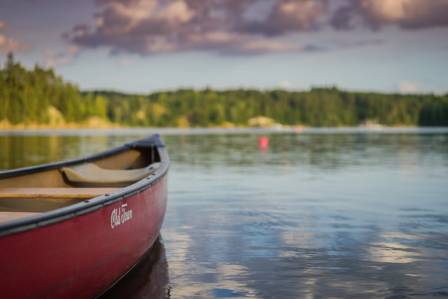
Ocean canoeing does not mean avoiding adventure. Thompson has explored the British Columbia coastline in a Prospector canoe since the 1990s, reaching remote destinations where canoes are rarely seen, including the rugged Brooks Peninsula on Vancouver Island’s western shore.
He believes that with patience and proper weather judgment, canoes can access many of the same locations as sea kayaks. Their strength and easier entry and exit can even provide advantages in certain situations. A loaded kayak may struggle with difficult launches or landings, while a canoe can sometimes handle these conditions more effectively. In larger waves or heavy swells, adding a spray deck can make a canoe surprisingly capable in challenging water.
A Tradition Connected to Coastal History
New ocean canoe instructor Julia McIntyre-Smith says paddling a canoe along the coast brings a special sense of pride. As a member of the Musgamagw Dzawa’daenuxw community from Ukwanalis (Kingcome), British Columbia, she points out that Indigenous communities have traveled these waters by canoe for generations.
She shares stories passed down from elders about entire communities making long-distance canoe journeys, including trips to Steveston to harvest apples and continuing into the United States for hop picking. These routes covered hundreds of nautical miles and involved powerful currents, open crossings, and exposed coastal conditions.
Canoeing as a Connection to Indigenous Heritage
The canoe has always been deeply connected to the history and culture of the coast.
Pete Smolders, a former instructor with the Coastline Challenge program that took youth on 26-day expeditions along the West Coast, asks why modern paddlers should not continue a tradition that Indigenous peoples have practiced for thousands of years.
Some instructors also believe that sea kayaking can introduce beginners to ocean environments before they have developed enough experience. Canoeing, by contrast, requires greater technical ability and practice from the beginning.
Alexander compares the difference by saying that sea kayaking can be like simply striking a drum, while coastal canoeing is closer to playing a violin—it demands more skill, control, and understanding.
The Challenge of Coastal Canoeing
For those who doubt the ability of canoes on the open ocean, Alexander offers a simple challenge: come along and try it yourself.
Coastal canoeing may be less common than sea kayaking, but its combination of history, versatility, skill, and adventure continues to attract dedicated paddlers who believe the canoe still has a rightful place on the world’s oceans.
More to explore
· en
Seeking the world’s largest glaciers
Ronan Whitlock
· en
Frozen Reservoirs: The Geology and Global Impact of Glaciers and Ice Sheets
Theodore Davis
· en
Artistic Guide: Illustrating a Rural Landscape by the River
Nicholas Aaron Whitfield
· en
10 fascinating facts about Adélie penguins
Grace Mitchell

· en
The Best Plants for Windowsill Gardens
Selene Hart
· en
The Art of Modern Washū: 9 Architect-Designed Living Rooms & Key Elements of Elevated Style
Daisy Chapman