Feature story
The world's tallest flying bird
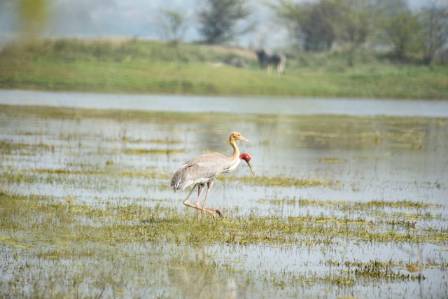
The Sarus Crane (Antigone antigone) is a magnificent bird species known for its extremely long legs and impressive height.
Emily Carter
Writer
Lounge note
Settle in — the full story and key updates are below.
Desk
Entertainment
Sarus Crane
The Sarus Crane (Antigone antigone) is a magnificent bird species known for its extremely long legs and impressive height. It is recognized as the tallest flying bird in the world, reaching an average height of approximately 150 centimeters.
Habitat
Sarus Cranes mainly live in wetlands, marshlands, and open grassland environments where they can find suitable food and nesting areas.
-
These cranes are distributed across India, Nepal, and several regions of Southeast Asia.
-
Within India, they are commonly seen in states such as Uttar Pradesh, Bihar, Rajasthan, and Assam.
-
They have a strong association with wetland habitats and depend on these areas for survival.
-
The Sarus Crane is officially recognized as the state bird of Uttar Pradesh.
-
Outside South Asia, they can also be found in parts of Australia, especially in Queensland and the Northern Territory.
Conservation Status
The Sarus Crane is listed as a “Vulnerable” species by the International Union for Conservation of Nature (IUCN).
In India, the species receives legal protection under Schedule 3 of the Wildlife Protection Act of 1972, which helps prevent illegal hunting and capture.
Threats Facing Sarus Crane Populations
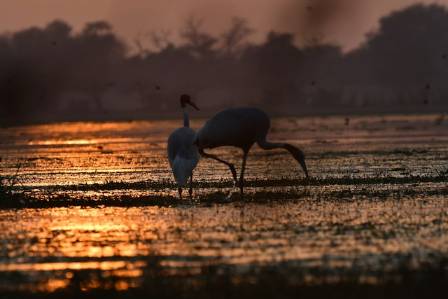
Several factors have contributed to the decline of Sarus Crane populations:
-
The destruction and reduction of wetland habitats are among the biggest threats to their survival.
-
Hunting and human disturbance near breeding locations also negatively affect their populations.
-
The use of pesticides and contamination from other pollutants can harm both the birds and their food sources.
Cultural Importance in India
The Sarus Crane holds significant cultural and religious importance in many parts of India, especially in Uttar Pradesh, where it is honored as the state bird.
-
In Hindu traditions, the crane is linked with Lord Brahma, the creator of the universe.
-
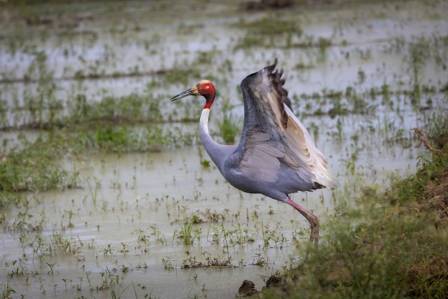
According to mythology, the bird’s red-colored head represents the creative power and energy of Lord Brahma.
-
he Sarus Crane is also regarded as a symbol of fertility, good fortune, and prosperity.
Conservation of the Sarus Crane
1. Protection and Restoration of Habitats
Since Sarus Cranes depend heavily on wetlands, protecting and maintaining these ecosystems is essential for their continued survival. Human activities such as farming expansion, urban development, and industrial growth can destroy important wetland areas and should be carefully managed.
Restoring damaged wetlands can create additional habitats for the cranes. This may include planting native plants, removing harmful invasive species, and managing water levels to maintain suitable environments.
2. Public Awareness Programs
Increasing awareness among local residents, farmers, and other stakeholders is an important part of Sarus Crane conservation.
Educational initiatives, community-based conservation projects, and media campaigns can help people understand the importance of protecting this species and its natural habitat.
3. Strengthening Legal Protection
The Sarus Crane is protected under India’s Wildlife Protection Act, which prohibits activities such as hunting, killing, and capturing the species.
Strict enforcement of these regulations, along with stronger penalties for illegal actions, can reduce threats and support population recovery.
4. Promoting Sustainable Farming Methods
Sarus Cranes often use agricultural landscapes as feeding areas. Encouraging environmentally friendly farming practices, including reducing the use of pesticides and chemical herbicides, can protect the birds and maintain healthier food resources.
5. International Conservation Cooperation
Because Sarus Cranes may travel across borders into countries such as Pakistan, Nepal, and other parts of Southeast Asia, cooperation between different nations is necessary.
Joint conservation efforts, information sharing, and coordinated protection programs can help safeguard the species throughout its range.
More to explore

· en
Embark on a journey beyond boundaries: explore the wonders of Slovenia
William Henry Clark

· en
Indoor Plants: A Year-Round Source of Wellness
Olivia Bennett

· en
A Look at Some of the Littlest Vehicles from Around the Globe
Riley Brooks

· en
Tokyo Tower
Charlotte Mae Thompson

· en
Who’s the Coolest Robot of All?
Evren Calder

· en
Strategies for Selecting the Premier Rotisserie Chicken
Logan Patrick Montgomery