Feature story
A Look at Some of the Littlest Vehicles from Around the Globe
When people visit automotive museums, the microcars they usually encounter are well-known models such as the BMW Isetta or the Messerschmitt KR175. However, the microcar world is far more diverse than most enthusiasts realize. Hundreds of tiny vehicle designs were created during the mid-20th century, and many never advanced beyond the prototype stage. That makes discovering an obscure and seldom-seen microcar a particularly exciting experience.
Riley Brooks
Writer
Lounge note
Settle in — the full story and key updates are below.
Desk
Entertainment
When people visit automotive museums, the microcars they usually encounter are well-known models such as the BMW Isetta or the Messerschmitt KR175. However, the microcar world is far more diverse than most enthusiasts realize. Hundreds of tiny vehicle designs were created during the mid-20th century, and many never advanced beyond the prototype stage. That makes discovering an obscure and seldom-seen microcar a particularly exciting experience.
In the first installment of this two-part series, we explore Europe, where the 1950s represented the golden age of microcar development. Following World War II, restrictions placed on German military manufacturers pushed many companies toward civilian transportation projects. At the same time, the 1956 Suez Crisis caused fuel shortages across Europe, encouraging the development of compact, economical vehicles.
Mathis VL333 (France)
Before World War II, Mathis was one of France’s leading automobile manufacturers and ranked fourth in national production. During the German occupation in 1942, the company secretly developed the VL333 prototype despite restrictions on civilian vehicle projects.
The unusual three-wheeled vehicle featured a streamlined egg-shaped body constructed from lightweight aluminum panels. Designed to carry three passengers, it was powered by a 700cc twin-cylinder engine. Only nine examples were completed.
The VL333 appeared at the 1946 Paris Motor Show, but postwar material shortages prevented Mathis from putting the vehicle into production. As a result, the project was abandoned. Today, the sole surviving example can be found at the Tampa Bay Automobile Museum in Florida.
Trabant (East Germany)
The fall of the Berlin Wall in 1989 marked the beginning of the end for East Germany’s most famous automobile, the Trabant. Produced from 1957 until 1991, it became an icon of life behind the Iron Curtain.
Its name translates to “satellite” in German and was inspired by the Soviet Sputnik satellite, which launched during the same year the car debuted.
One of the Trabant’s most distinctive features was its body construction. Instead of steel, it used Duroplast, a composite material made from recycled cotton fibers and phenolic resin.
Following German reunification, countless Trabants were dismantled. Their bodies were shredded and repurposed into construction materials used for paving projects. In a sense, the car continued its life in another form.
Visitors to Berlin’s Trabi Museum can learn the full story of the Trabant and see a 1963 Trabant 601 displayed bursting through a replica section of the Berlin Wall.
Scootacar (United Kingdom)
Introduced in 1957, the Scootacar was developed by the Hunslet Engine Company, a British manufacturer better known for building locomotives.
Essentially an enclosed scooter with four seats, the Scootacar featured a fiberglass body and was powered by a 9-horsepower Villiers air-cooled engine. It delivered exceptional fuel economy and was intended as an affordable urban commuter.
Because the vehicle was taller than it was wide, it earned the nickname “the telephone box.”
Production lasted from 1957 to 1964, with approximately 1,000 units built.
A 1959 Scootacar Mk I is currently preserved at the Lakeland Motor Museum in Cumbria, England.
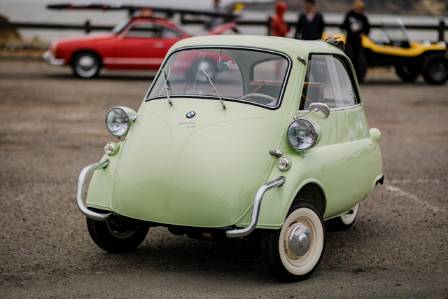
Heinkel Kabine (West Germany)
Between 1956 and 1958, aircraft manufacturer Heinkel shifted its attention from aviation to small-scale transportation due to postwar restrictions on aircraft production.
Company founder Ernst Heinkel admired the success of the Isetta and aimed to create a microcar that was lighter, faster, and more practical.
Like the Isetta, the Kabine used a front-opening door that swung outward to provide cabin access. To avoid patent disputes, however, the steering wheel remained fixed rather than moving with the door.
Measuring just over eight feet in length and weighing around 535 pounds, the Kabine was powered by a single-cylinder four-stroke engine producing 10 horsepower. It could reach speeds of roughly 50 mph and even included a reverse gear, a feature not always found in bubble cars of the era.
Although more than 6,000 examples were manufactured, only a handful remain today. One 1957 Type 153 is displayed at the Midwest Microcar Museum in Wisconsin.
Zündapp Janus (West Germany)
Launched in 1957 by motorcycle manufacturer Zündapp, the Janus remains one of the most unusual microcars ever produced.
Named after the Roman god Janus, who looked both forward and backward, the car reflected this theme through its unique layout. It featured doors at both the front and rear, with rear passengers seated facing backward.
Its fold-flat seating arrangement even allowed the cabin to be converted into a compact sleeping area.
Despite its tiny dimensions, the Janus incorporated advanced engineering for its time, including MacPherson strut suspension, rack-and-pinion steering, and a four-speed gearbox. Its 245cc engine provided a top speed of approximately 50 mph.
Production lasted only two years. Today, a 1958 example is preserved at Stahl’s Automotive Foundation in Michigan.
Mikrus MR-300 (Poland)
The name Mikrus translates roughly to “little one,” an appropriate description for this compact Polish automobile.
Produced from 1958 through 1960 by WSK, a company previously known for manufacturing MiG fighter aircraft, the MR-300 featured flowing curves influenced by aviation-era metalworking equipment.
Powered by a modest 14-horsepower two-stroke engine, the vehicle was intended to provide affordable transportation for ordinary families.
Although demand was strong among consumers seeking personal mobility, production unexpectedly ended after only 1,728 units were built.
A 1959 MR-300 can be seen at the Museum of Engineering and Technology in Kraków, while another example resides at the Lane Motor Museum in Tennessee.
Peel P50 (Isle of Man)
Manufactured between 1963 and 1966, the Peel P50 earned global fame as the smallest production car ever built.
This ultra-lightweight three-wheeler seated a single occupant and used a small DKW motorcycle engine for propulsion. The entire vehicle weighed only around 130 pounds.
Because the three-speed transmission lacked a reverse gear, engineers cleverly installed a handle at the rear. Drivers could simply lift the back of the vehicle and turn it around manually.
One of the most famous surviving examples, a bright red 1964 P50, is displayed at the National Motor Museum in Beaulieu, England.
Smart Car (Germany/Switzerland, Built in France)
Nearly four decades after the original bubble-car era, microcars experienced a modern revival with the arrival of the Smart City Coupe in the late 1990s.
Measuring only eight feet long, the two-seat city car was specifically designed for crowded urban environments and could be parked sideways in tight spaces.
The project was a collaboration between watchmaker Swatch and Daimler-Benz. Early plans called it the “Swatchmobile,” but the final name became Smart, combining elements of Swatch, Mercedes, and the word “art.”
A 0.6-liter turbocharged three-cylinder engine produced 53 horsepower, allowing the lightweight vehicle to reach speeds of approximately 84 mph.
A 2000 Smart police vehicle is displayed at the State Police Car Museum in Rome, where it represents the model’s use in city-based law enforcement duties.
Alta 200 (West Germany/Greece)
The Alta 200 was built in Greece under license from Germany’s Fuldamobil.
Produced between 1968 and 1974, the three-wheeled sedan featured a stylish fiberglass body and a single driven rear wheel. Power came from a 200cc Heinkel four-stroke engine generating 10 horsepower.
Despite its modest output, the vehicle could achieve speeds of around 56 mph while delivering excellent fuel efficiency.
With its attractive curved bodywork stretching just over ten feet in length, the Alta 200 stood out among late-era microcars.
A fully restored example can be viewed at the Hellenic Motor Museum in Athens.
Looking Ahead
Europe’s microcar movement produced some of the most creative and unconventional vehicles in automotive history. From postwar transportation solutions to engineering curiosities, these miniature machines captured the imagination of a generation.
In the next installment, we will travel to Japan and the United States to explore how Japan elevated microcar design into an art form and why these tiny vehicles never achieved the same level of success in America.
More to explore

· en
The Secret Life of Hermit Crabs
Kellan Voss

· en
Why San Francisco Is The Most Beautiful City On Earth
Ronel Hartwell

· en
Meet the Belted Kingfisher
Oscar Reed

· en
Fujian Tulou: Ancient Earthen Castles of China
Levi Marlowe

· en
The Definitive Guide to Styling Ankle Boots for Every Occasion
Frederick Carlisle

· en
Most Beautiful Clownfish Species for Saltwater Tanks
Celine Brooks