Feature story
Top 8 Most Powerful Rockets in the World
Rockets are the primary vehicles used to transport spacecraft, equipment, and other payloads beyond Earth. However, launch vehicles differ greatly in their lifting ability and engine power.
Seren Alden
Writer
Lounge note
Settle in — the full story and key updates are below.
Desk
Entertainment
Rockets are the primary vehicles used to transport spacecraft, equipment, and other payloads beyond Earth. However, launch vehicles differ greatly in their lifting ability and engine power.
This article examines eight of the most powerful rockets, focusing on their payload capacities, thrust, dimensions, development history, and roles in space exploration.
1. Saturn V
The Saturn V was an American launch vehicle that was retired in 1973. It remains one of the largest, heaviest, and most powerful rockets ever successfully flown. The vehicle was launched 13 times from Kennedy Space Center, demonstrating a strong operational record.
Standing approximately 363 feet tall, Saturn V operated from November 1967 through May 1973. It was capable of placing payloads weighing as much as 310,000 pounds into Earth orbit.
2. Long March 9
The Long March 9 is a super-heavy launch vehicle conceived in China and developed for future space missions. The rocket is expected to reach a height of roughly 360 feet.
Its planned payload capacity is approximately 300,000 pounds when delivering cargo into low Earth orbit. The vehicle is intended to support future large-scale space missions, with an initial launch planned for 2028.
3. SpaceX Starship
SpaceX Starship is an American spacecraft and launch system currently under development. The enormous vehicle is approximately 387 feet tall and is designed to carry around 110 tons of payload into low Earth orbit.
The launch system has been designed with ambitious deep-space exploration goals in mind. One of its major purposes is to support the transportation of people and equipment to Mars as part of SpaceX's broader plans for establishing a human presence on the planet.
4. Falcon Heavy
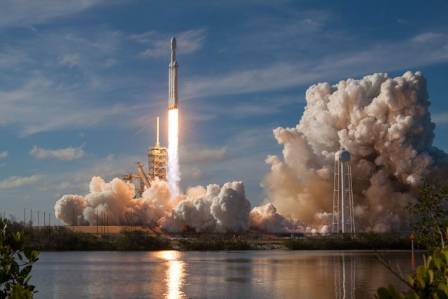
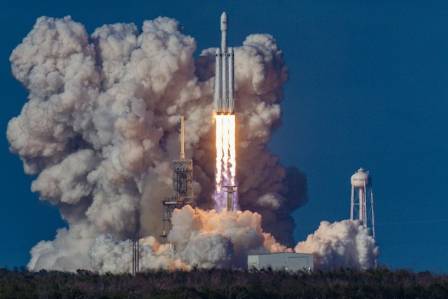
Falcon Heavy represents an important development in SpaceX's efforts to create powerful launch vehicles for demanding space missions. The rocket stands approximately 230 feet tall and is capable of generating millions of pounds of thrust during liftoff.
The vehicle entered operational service in 2018 and can transport approximately 140,660 pounds of payload into low Earth orbit. Falcon Heavy uses three booster cores, with its boosters designed to separate after launch and return for potential reuse.
5. Space Launch System
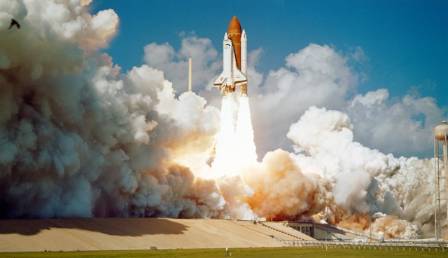
NASA's Space Launch System, commonly known as SLS, is a heavy-lift rocket measuring approximately 365 feet in height. It is designed to transport payloads weighing up to about 209,000 pounds into Earth orbit.
The launch vehicle was developed in the United States to support NASA's Orion program. Orion is intended to transport astronauts beyond low Earth orbit, including missions involving the Moon and future exploration of Mars.
6. Energia
Energia was a powerful Soviet launch vehicle developed to support human spaceflight and other demanding missions. The rocket successfully reached orbit twice during its operational history.
The vehicle was estimated to have a payload capability of approximately 100 tons. Following the dissolution of the Soviet Union, the Energia program was discontinued, bringing its relatively short operational history to an end.
7. New Glenn
New Glenn is a heavy-lift launch vehicle being developed in the United States by Blue Origin. The rocket is approximately 230 feet tall and is designed to carry around 140,700 pounds into low Earth orbit.
The launch vehicle is powered by nine BE-4 engines. Its first stage is designed to generate several million pounds of thrust during liftoff, providing the force required to propel the vehicle away from Earth.
New Glenn is intended to serve as a major commercial heavy-lift launch system and is designed with reusable components to support future spaceflight operations.
8. Space Shuttle
The Space Shuttle was an American reusable spacecraft system that operated from April 1981 through July 2011. The vehicle stood approximately 180 feet tall when combined with its launch configuration and could deliver payloads weighing as much as 60,000 pounds into low Earth orbit.
The shuttle system relied on two powerful solid rocket boosters to help propel it away from Earth during launch. Across its operational period from 1981 to 2011, the Space Shuttle fleet completed 135 missions.
Final Thoughts
Advances in aerospace engineering have gradually produced increasingly sophisticated rockets and spacecraft capable of supporting complex missions beyond Earth. Improvements in propulsion, materials, navigation, reusability, and spacecraft design have helped overcome many of the limitations encountered by earlier generations of launch vehicles.
As technology continues to develop, increasingly capable rockets are being designed to support a wider range of space activities. These vehicles may contribute to future exploration of the Moon, Mars, and other destinations while expanding humanity's ability to operate beyond Earth.
The history of powerful launch vehicles demonstrates how advances in rocket engineering have continually expanded the possibilities of space exploration.
More to explore

· en
How To Choose The Perfect Women's Suit
Seraphine Crowe

· en
The Ultimate Blueberry Smoothie: A Simple Blend for Energy, Nutrition, and Wellness
Miles Harrison

· en
A Lakeside Swedish Log House In The Snow
Callum Hayes

· en
Strawberry Milkshake Without Ice Cream
Julian Vance

· en
Health Benefits of Blueberries: A Nutrient-Dense Superfruit for Overall Wellness
Victoria

· en
What is Snowboarding?
Ronan Frost