← Back home3 min read
Feature story
The Evolution of the Gymnastics Pommel Horse
Men’s artistic gymnastics on the pommel horse traces its roots to practical training with living horses, specifically equus caballus. Its history can be traced back to Alexander the Great and his Macedonian soldiers around 315 BC, who practiced mounting and dismounting horses using an early version of the pommel horse.
E
Ethan Collins
Writer
Lounge note
Settle in — the full story and key updates are below.
Desk
Entertainment
Men’s artistic gymnastics on the pommel horse traces its roots to practical training with living horses, specifically equus caballus. Its history can be traced back to Alexander the Great and his Macedonian soldiers around 315 BC, who practiced mounting and dismounting horses using an early version of the pommel horse.
These early models were simple wooden structures shaped like a horse’s back, without the handles or padding seen in today’s gymnastics apparatus. The Roman military also employed similar devices to train soldiers in mounting and maneuvering real horses.
Gymnastics as a discipline has historically intertwined with military training. The pommel horse served as a method for developing strength, coordination, and dexterity, which were essential for combat. In the 17th century, European knights continued to use horse-shaped apparatuses to refine their skills for mounted combat and equestrian competitions, maintaining the tradition well into the 18th century.
The modern gymnastics movement owes much to Friedrich Ludwig Jahn, a former Prussian soldier often called the father of contemporary gymnastics. Though gymnastic exercises existed in ancient Greece, the practice declined over time until Jahn revived it in the early 19th century. Following Prussia’s defeat by Napoleon, Jahn advocated for physical and mental rejuvenation through gymnastics, founding the first outdoor gymnasium known as the Turnplatz.

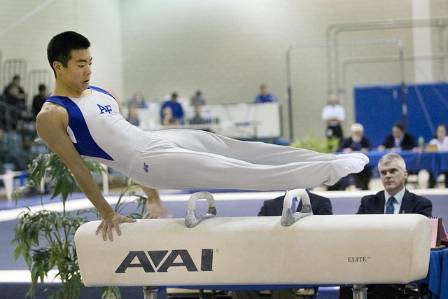
From Jahn’s revival until 1936, the pommel horse underwent various transformations. Earlier designs mimicked the natural curves of a horse, making complex swinging movements more challenging. By the 1920s, a sleeker form with a slightly curved lower torso was used, including at the 1936 Berlin Olympics, measuring 180 cm (71 inches) in length. Gymnasts performed swings on both the neck and rump, but it was not until the Americans introduced a fully symmetrical 160 cm (63 inches) version in 1948 that the standardized shape we recognize today emerged. This form was officially certified by the International Gymnastics Federation (FIG) in 1956.
The pommels themselves evolved depending on the intended use. Military or equestrian training often required none or minimal handles, while gymnastics incorporated raised pommels to provide support and allow a greater variety of movements and transitions. By the mid-19th century, two-legged swings became common, prompting adjustments to pommel design. Early pommels were mostly hollow iron, later incorporating wood and leather coverings. The 1936 Olympic pommels were flatter compared to earlier designs, reflecting evolving techniques.
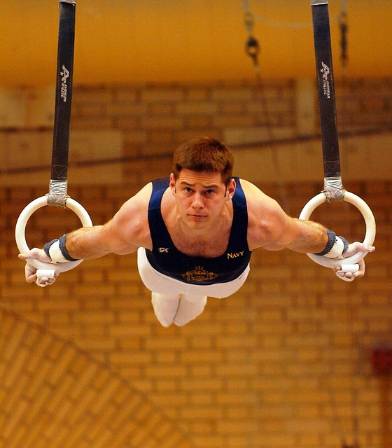
Influential gymnasts shaped the development of the apparatus. Figures such as Grant Schaginjan, Yu Lifeng, Russel Mills, Miroslav Cerar, and Zoltan Magyar pushed the boundaries of skill, creating demand for longer and more versatile pommels. By 1974, pommels were extended from 280 mm to 310 mm to accommodate advanced movements.
Today, pommel horses are manufactured to FIG specifications, ensuring safety and uniformity. Early 20th-century handles were made from solid steel, upholstered in leather, and mounted on brass bases. Many of these antique apparatuses, once considered obsolete, are now prized collectibles and occasionally repurposed as decor.
More to explore

· en
The Remarkable Family Life of the White-Crested Laughingthrush
Livia West

· en
Most Reliable SUVs
Anthony Morgan

· en
Reasons to Grow Spider Plants
Elara Hayes

· en
The golden eagle is a bird of massive size and imposing presence.
Mason Blake

· en
The largest known terrestrial gastropod is the giant African land snail
Therin Cole

· en
American Pika: The Tiny Mountain Survivor Facing a Changing Climate
Dorian Reeves