← Back home2 min read
Feature story
8 Little-Known Facts About Independence Hall
Here are eight things you probably didn’t know about Independence Hall—perfect for trivia night or your next visit.
E
Ethan Clark
Writer
Lounge note
Settle in — the full story and key updates are below.
Desk
Entertainment
Here are eight things you probably didn’t know about Independence Hall—perfect for trivia night or your next visit.
A Georgian Masterpiece Finished in 1748
Construction of the building—first known as the Pennsylvania State House—began in 1732 under Speaker Andrew Hamilton. Designed by master builder Edmund Woolley, it was intended to host all three branches of Pennsylvania’s colonial government. The structure was completed in 1748, though its tower came later.
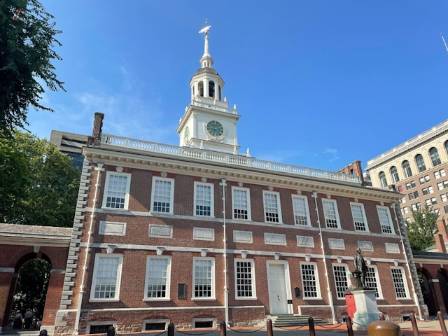
Its exterior remains largely unchanged since the 1700s, featuring marble keystones, a hand-carved wooden cornice, a rooftop balustrade, and a graceful Palladian window on the south side.
Neither Clock Is Original
Two clocks adorn Independence Hall today—but both are replacements. The first, a tall grandfather clock on the west end, was crafted by Thomas Stretch in 1753. Its mechanisms linked to dials on both ends of the building.
This clock was taken down around 1830; a replica was installed in 1973. Interestingly, it took Pennsylvania six years to pay Stretch.
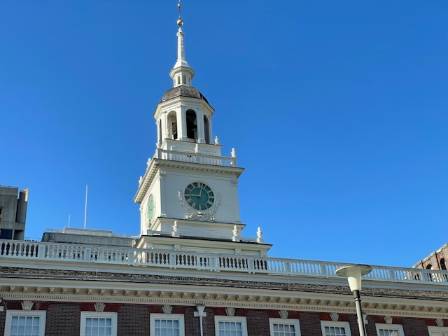
The steeple clock came much later. The original steeple was removed in 1781, and the current one—designed by William Strickland—was added in 1828. Its clock reflects a growing cultural emphasis on punctuality in the 19th century.
Where the Declaration Was Signed
It was in the Assembly Room of Independence Hall that the Second Continental Congress debated, revised, and ultimately signed the Declaration of Independence.
The motion passed on July 2, 1776; Thomas Jefferson drafted the document in two days. By August 2, delegates had signed one of history’s most transformative texts. The room has been restored to its late-18th-century appearance and is now open to the public.
The Constitution Was Born Here
From May to September 1787, the same Assembly Room hosted the Constitutional Convention. The Founding Fathers gathered to replace the failing Articles of Confederation, resulting in the visionary U.S. Constitution.
George Washington later marveled that such a profound achievement took only four months.
Lincoln Lay in Honor Here
After his assassination, Abraham Lincoln’s body was brought to Independence Hall, where he lay in state for two days. More than 85,000 people came to pay their respects.
Lincoln had spoken here as president-elect, expressing deep reverence for the ideals the hall embodied.
Once a Dog Pound
For a time, the basement of Independence Hall served as Philadelphia’s municipal dog pound—a humble use for a place now so revered, but a practical solution for its time.
Home of the Liberty Bell
The Liberty Bell first hung in the original steeple. When that was removed, the bell was moved to the brick tower until the 1850s. It was then displayed on the ground floor until 1976.
Today, the Centennial Bell hangs in the steeple, while the Liberty Bell is showcased across the street at the Liberty Bell Center.
Almost Destroyed
In 1816, Philadelphia bought the entire block containing Independence Hall to prevent a real estate project that would have demolished the building. This far-sighted preservation effort saved a national treasure.
More to explore
· en
Racing Steel: The World’s 10 Fastest High-Speed Trains
Alex
· en
The Evolution of the Gymnastics Pommel Horse
Ethan Collins
· en
Describe the beauty of the Jiangnan water town
Blake Rivers
· en
Fujian Tulou: Ancient Earthen Castles of China
Levi Marlowe

· en
Iconic Flower Paintings
Miles Grant
· en
Master Class: Techniques for Painting a Desert Landscape
Caroline Faith Waverly