Feature story
The mystery of Easter Island revealed?
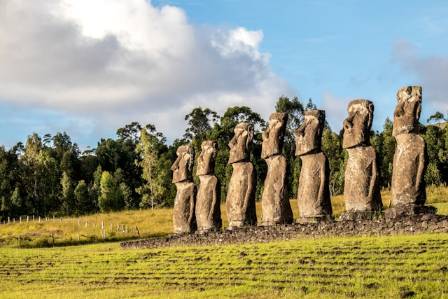
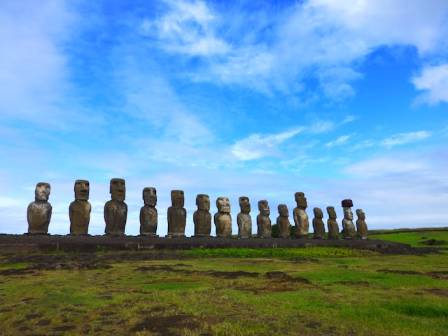
Rapa Nui, better known around the world as Easter Island, is famous for its mysterious Moai, enormous stone figures that have watched over the island for centuries. These remarkable monuments demonstrate extraordinary human skill, while the reasons behind their creation have remained the subject of considerable debate.
Serena Langford
Writer
Lounge note
Settle in — the full story and key updates are below.
Desk
Entertainment
Rapa Nui, better known around the world as Easter Island, is famous for its mysterious Moai, enormous stone figures that have watched over the island for centuries. These remarkable monuments demonstrate extraordinary human skill, while the reasons behind their creation have remained the subject of considerable debate.
According to a recent study by Jo Anne Van Tilburg, director of the Easter Island Statue Project, ancient Rapanui sculptors created nearly 1,000 Moai at the direction of the island’s ruling elite. The community believed that the statues possessed the power to encourage agricultural fertility and, in turn, help secure the food supplies essential to their survival.
Van Tilburg and her research team, working alongside geoarchaeologist and soil specialist Sarah Sherwood, believe they have uncovered scientific evidence supporting this long-standing theory. Their conclusions come from detailed research on two Moai excavated over a period of five years at Rano Raraku, the quarry located on the eastern side of Rapa Nui.
The latest research examined two statues situated within the inner portion of Rano Raraku. Around 95 percent of the island’s more than 1,000 Moai originated from this quarry. Extensive laboratory analysis of soil collected from the same area revealed evidence of crops including bananas, taro, and sweet potatoes.
The findings indicate that Rano Raraku was more than simply a location where stone was extracted and statues were carved. It also appears to have supported productive agriculture.
“Our excavation broadens our perspective of the Moai and encourages us to realize that nothing, no matter how obvious, is ever exactly as it seems. I think our new analysis humanizes the production process of the Moai,” Van Tilburg said.
Van Tilburg has spent more than 30 years researching Rapa Nui. Her Easter Island Statue Project receives support from the UCLA Cotsen Institute of Archaeology. Tom Wake, another member of the institute, studies the remains of small animals recovered from the excavation area. Van Tilburg also directs UCLA’s Rock Art Archive.
Working together with members of the Rapa Nui community, Van Tilburg leads the first legally authorized excavations of Moai at Rano Raraku since 1955. The project is co-directed by Cristián Arévalo Pakarati, a prominent Rapanui artist.
Soil Fertility
Sherwood believes the soil at Rano Raraku may be the most fertile on the island, particularly when considered over a long period. The presence of a freshwater source within the quarry further strengthened the area’s agricultural potential.
According to Sherwood, the quarrying process itself may have contributed to improved soil quality and greater food production nearby. As workers dug farther into the local bedrock and carved the Moai, they exposed clay-rich material produced through the weathering of lapilli tuff.
Sherwood, a professor of earth and environmental systems at the University of the South in Sewanee, Tennessee, became involved with the Easter Island project after meeting one of Van Tilburg’s researchers at a geology conference.
Soil fertility was not originally the focus of her research. However, driven by curiosity and her scientific approach, she carried out detailed tests on samples collected from the quarry.
“When we got the chemistry results back, I did a double take,” Sherwood said. The samples contained unexpectedly high concentrations of calcium and phosphorus. The chemical composition also revealed elevated levels of several elements that are important for plant development and strong agricultural yields.
While soils elsewhere on the island were rapidly becoming depleted through erosion and the loss of plant-supporting nutrients, the quarry appeared to function differently. The continuous addition of tiny pieces of bedrock produced by quarrying created what Sherwood described as an effective natural cycle involving water, nutrients, and fertilizer.
The evidence also suggests that the ancient Rapanui understood their environment remarkably well. They appear to have cultivated several different crops within the same area, a practice that can contribute to maintaining soil productivity.
The two Moai excavated by Van Tilburg’s team were found standing upright exactly where they had originally been placed. One rested on a pedestal, while the other stood within a deep hole, suggesting that neither statue was intended to be moved elsewhere.
“This study radically alters the idea that all standing statues in Rano Raraku were simply awaiting transport out of the quarry,” Van Tilburg said. She believes these two statues, along with other upright Moai in the quarry, may have deliberately remained where they stood because their presence helped preserve the sacred character of Rano Raraku.
Within traditional Rapanui beliefs, the Moai were closely connected with fertility. Their continued presence at the quarry may have been understood as a force that encouraged agricultural production and helped sustain the community.
Mysteries Centuries in the Making
Van Tilburg and her colleagues estimate that the statues in the inner quarry were erected sometime between approximately A.D. 1510 and A.D. 1645, or possibly earlier. Activity in this section of Rano Raraku most likely began around A.D. 1455.
Most Moai production had ended by the early 18th century, following increasing contact with Europeans and other Western influences.
By the time Van Tilburg’s team began excavating the two selected statues, both had been almost entirely concealed beneath accumulated soil and stone debris.
The researchers carefully examined historical photographs before selecting the statues for excavation. They also mapped the entire inner section of Rano Raraku before beginning their archaeological work.
Building strong relationships with the local population has been an important part of Van Tilburg’s research on Rapa Nui. Local residents participate in both fieldwork and laboratory activities, working under the guidance and mentorship of professional archaeologists and geologists.
Their combined work has produced an extensive archive and comparative database documenting more than 1,000 sculptural objects on Rapa Nui, including the island’s famous Moai. The project has also compiled corresponding information on more than 200 related objects now held in museums around the world.
In 1995, UNESCO designated Easter Island as a World Heritage Site. Most of its important sacred archaeological locations are protected within Rapa Nui National Park.
The study represents the first definitive research to demonstrate that Rano Raraku was a complex and multifunctional landscape. More importantly, it establishes a direct connection between the quarry’s soil fertility, agricultural activity, stone extraction, and the sacred significance of the Moai.
Van Tilburg and her colleagues are continuing their investigations with another study focused on the rock art carved into the surfaces of just three of the Moai.
More to explore
· en
Master the Art of Pen and Ink: A Guide to Drawing Snow-Capped Mountains
Archer Beaumont
· en
Hamsters: From the Wild to Your Bedroom
Ethan Collins
· en
Exploring the Unique World of Elephant-Created Artworks
Augustus Wilder
· en
Intriguing Facts about Traditional Cave House Dwelling
Orion Prescott
· en
Fascinating Insights into the Australian Magpie
Lily Ward
· en
Autonomous Mobile Robots
Noah Reed